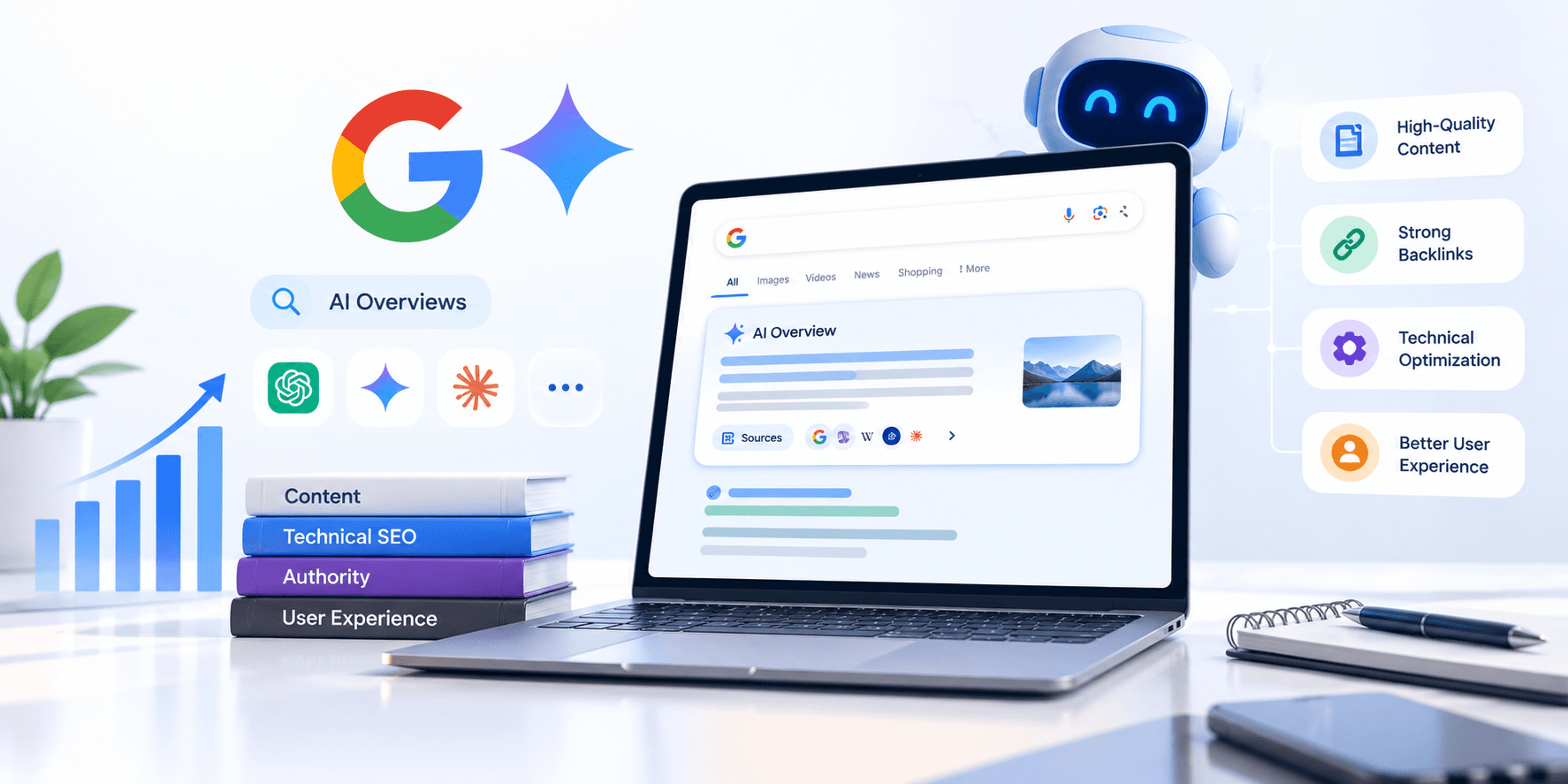
How to Rank in Google AI Overviews: A Complete SEO Guide

- Published
- Reading time
- 11 min
On this page 8 sections
Google Search is evolving beyond traditional blue links. With AI Overviews, users can receive AI-generated summaries, explanations and recommendations directly within search results, supported by links to relevant websites. This development is changing how people discover information, evaluate businesses and interact with online content.
For website owners, publishers and businesses, this creates a new opportunity to increase organic visibility beyond conventional search rankings. However, appearing in Google AI Overviews is not simply about adding AI-related keywords, implementing special schema or publishing large volumes of content. It requires a strong foundation in traditional SEO, helpful information, technical accessibility and subject-matter credibility.
So, how do you rank in Google AI Overviews?
The practical approach is to create content that deserves to be discovered, understood and referenced by Google's search systems. This guide explains the strategies, technical considerations and measurement methods businesses can use to improve their eligibility and potential visibility in Google's AI-powered search experiences.
What Are Google AI Overviews?
Google AI Overviews are AI-generated summaries that appear within Google Search for selected queries. They help users understand complex topics, explore information and discover relevant websites through supporting links.
Unlike conventional search snippets, AI Overviews can combine information from multiple sources to generate a contextual response to a user's question.
For example, someone searching for "best SEO strategy for ecommerce businesses" might receive an AI-generated overview covering technical SEO, product optimization, content strategy and website performance, alongside links to relevant resources.
Google's official documentation on AI features in Search explains how AI Overviews and AI Mode provide additional ways for websites to appear in search experiences.
For businesses, the opportunity is to become a useful and credible source within the topics relevant to their products, services and expertise.
How Does Google Select Content for AI Overviews?
Google does not simply select the highest-ranking page for every AI Overview. Its systems identify relevant information from the Search index and may present links to pages that support different aspects of an answer.
Google's approach includes techniques such as retrieval-augmented generation (RAG) and query fan-out, where related searches help identify information across multiple subtopics.
This means a website may have opportunities to appear for relevant supporting questions, even when its content does not exactly match the original search phrase.
However, Google does not guarantee inclusion. Pages must meet the applicable technical requirements and be eligible to appear in Google Search with a snippet.
Read Google's guide to optimizing websites for generative AI features for its official recommendations.
10 Proven SEO Strategies to Improve Google AI Overviews Visibility
1. Create Helpful, Original and Experience-Based Content
Originality is one of the most important considerations when developing content for AI-powered search experiences.
Publishing generic articles that repeat information already available across hundreds of websites does not establish meaningful expertise.
Instead, create content that provides additional value through:
- Original research and industry insights.
- First-hand experience and practical examples.
- Expert explanations and informed opinions.
- Unique case studies and performance data.
- Detailed comparisons and practical recommendations.
- Clear answers to real customer questions.
For example, an SEO agency writing about technical SEO should go beyond explaining what technical SEO means. It can demonstrate how crawlability, indexing, canonicalization and internal linking affect actual website performance.
Google's Creating Helpful, Reliable, People-First Content documentation provides guidance on developing content that serves readers rather than simply targeting search engines.
2. Answer Search Queries Clearly and Directly
AI-powered search experiences are designed to help users understand information efficiently.
Structure important sections around specific questions and provide direct, accurate answers before expanding into detailed explanations.
For example:
Question: What is technical SEO?
Technical SEO is the process of improving a website's technical structure so search engines can discover, crawl, render and index its important pages effectively.
Follow the direct answer with practical details, examples, recommendations and relevant supporting evidence.
Useful content formats include:
- Question-and-answer sections.
- Step-by-step explanations.
- Comparison tables.
- Definitions and terminology.
- Practical checklists.
- Detailed industry guides.
Do not force every paragraph into a short-answer format. The objective is clarity and completeness, not writing exclusively for AI extraction.
3. Build Topical Authority Through Content Clusters
A single article rarely demonstrates comprehensive expertise across an entire subject.
Develop interconnected content around your primary business topics to establish a broader and more useful information ecosystem.
For example, an SEO agency could create a content cluster around AI search optimization:
- What is Google AI Overviews?
- How to rank in Google AI Overviews.
- Google AI Overviews vs traditional search.
- What is Generative Engine Optimization?
- How to improve brand visibility in ChatGPT.
- AI SEO vs traditional SEO.
- How to measure AI search visibility.
Connect related articles through descriptive internal links so readers and search engines can discover relevant resources.
Avoid publishing multiple articles that simply repeat the same information with slightly different keywords. Each page should address a distinct search intent and provide meaningful additional value.
4. Strengthen E-E-A-T and Brand Credibility
Experience, Expertise, Authoritativeness and Trustworthiness are important concepts in Google's search quality framework.
Although E-E-A-T is not a single direct ranking factor, demonstrating credibility helps establish the quality and reliability of website content.
Businesses can strengthen credibility through:
- Detailed author biographies.
- Verifiable professional experience.
- Original case studies.
- Reliable external references.
- Accurate company information.
- Transparent editorial standards.
- Consistent brand identity.
- Updated and fact-checked information.
For example, an article discussing enterprise SEO should ideally reflect practical knowledge of website architecture, large-scale indexing, technical audits and content operations.
Support claims with reliable sources rather than making unsupported statements about rankings, performance or industry trends.
5. Improve Technical SEO and Crawlability
Before content can become eligible for AI Overview visibility, Google must be able to access and process the relevant website pages.
Important technical SEO activities include:
- Allowing Googlebot to crawl important content.
- Maintaining accurate XML sitemaps.
- Fixing unintended robots.txt restrictions.
- Managing canonical tags correctly.
- Resolving indexing problems.
- Improving internal linking.
- Ensuring important content is available in readable text.
- Checking JavaScript rendering.
- Fixing broken pages and unnecessary redirects.
Use Google Search Console to inspect URLs, monitor indexing and identify technical issues.
Google's Crawling and Indexing documentation provides additional technical guidance.
Remember that being indexed does not guarantee inclusion in AI Overviews, but an inaccessible or ineligible page cannot become a supporting search result.
6. Optimize Content Structure and Semantic Relevance
A well-organized article makes information easier for visitors to understand and navigate.
Use a logical heading hierarchy, descriptive subheadings, meaningful paragraphs and relevant lists.
For example, an article about Google AI Overviews could use sections such as:
- What are Google AI Overviews?
- How does Google select supporting sources?
- How can websites improve AI search visibility?
- What technical SEO requirements matter?
- How should AI Overview performance be measured?
Use related terminology naturally. An article about AI Overviews may also discuss organic search, AI Mode, search intent, crawling, indexing, content quality and search visibility.
Do not insert keywords unnaturally or create unnecessary sections simply to increase keyword density.
7. Use Structured Data Correctly
Structured data helps search engines understand specific information about a webpage and can make eligible pages qualify for certain rich results.
Depending on the content, relevant structured data may include:
- Article.
- Organization.
- BreadcrumbList.
- Product.
- LocalBusiness.
- Relevant other supported types.
Ensure that structured data accurately represents information visible to users and follows Google's documentation.
Use the Google Rich Results Test to check eligible markup and the Schema Markup Validator to validate schema syntax.
An important distinction: Google does not require special AI Overview schema or dedicated AI markup to appear in AI Overviews. Structured data should support your overall SEO implementation, not be treated as an AI ranking shortcut.
8. Strengthen Internal Linking and Relevant External References
Internal linking helps search engines discover related pages and helps readers explore additional information.
For example, a website discussing AI Overviews can connect related topics such as technical SEO, content optimization, GEO and AI SEO services.
Use descriptive anchor text that accurately explains the destination page.
External references should support factual claims and provide access to authoritative information, including Google's official documentation, research publications and relevant industry resources.
Relevant editorial mentions and citations can also contribute to broader brand discovery, although no particular number of backlinks or mentions guarantees AI Overview inclusion.
9. Optimize Images, Videos and Page Experience
Search visibility is not limited to text.
Relevant images, explanatory diagrams, original screenshots and useful videos can make content more informative and improve the overall user experience.
For effective implementation:
- Use descriptive image filenames.
- Write meaningful alt text.
- Compress images without sacrificing quality.
- Use responsive image formats.
- Include relevant captions where useful.
- Embed helpful videos when they add value.
- Maintain a mobile-friendly layout.
Also monitor loading performance, responsiveness and visual stability.
Use Google PageSpeed Insights and Core Web Vitals documentation to identify performance improvements.
10. Measure AI Search Visibility and Organic Performance
SEO measurement should extend beyond conventional keyword rankings.
Monitor website performance through:
Google Search Console: Track impressions, clicks, CTR, queries, landing pages and indexing.
Google Analytics 4: Measure organic sessions, engagement, conversions and revenue.
AI visibility monitoring: Track brand mentions, citations and references across AI-powered search platforms using appropriate third-party tools.
Content performance: Identify pages that attract relevant traffic and generate meaningful engagement.
Google's AI features documentation explains that traffic from AI features is included in Search Console's overall Web search reporting. It is not presented as a separate traditional AI Overview traffic channel in the standard Performance report.
Therefore, use a combination of Search Console, analytics and carefully interpreted AI visibility monitoring rather than relying on one metric.
Google AI Overviews SEO: Common Myths to Avoid
Several misconceptions have emerged around optimizing websites for AI-generated search results.
Myth 1: You need special AI schema to rank.
Reality: Google does not require dedicated AI Overview structured data.
Myth 2: Publishing more content guarantees AI visibility.
Reality: Publishing large quantities of repetitive or low-value content does not establish authority.
Myth 3: You must create an llms.txt file to appear in AI Overviews.
Reality: Google's official guidance does not require llms.txt or special AI-readable files for its generative search features.
Myth 4: Keyword stuffing helps AI extract answers.
Reality: Natural language, relevance, accuracy and helpful content are more important than repetitive keyword placement.
Myth 5: Ranking first guarantees an AI Overview citation.
Reality: AI Overview source selection is not guaranteed by a conventional organic ranking position.
For additional clarity, consult Google's official guide to optimizing for generative AI features, which addresses several commonly circulated optimization misconceptions.
SEO vs GEO: What Is the Difference?
Search Engine Optimization (SEO) focuses on improving website visibility across traditional search results and other search experiences.
Generative Engine Optimization (GEO) focuses on improving brand and content visibility in generative AI platforms and AI-generated responses.
The two disciplines overlap in important areas, including content quality, technical accessibility, brand authority and topical relevance.
For businesses, an integrated approach can support visibility across Google Search, AI Overviews, AI Mode and other conversational search experiences.
Explore GEO Digital Agency for more information about generative engine optimization and AI search visibility.
You can also explore AI SEO Marketing to understand how AI-focused optimization can complement a broader organic search strategy.
How Long Does It Take to Appear in Google AI Overviews?
There is no fixed timeline for appearing in Google AI Overviews.
Visibility depends on several factors, including whether a page is indexed, its relevance to the search query, content quality, technical accessibility and Google's selection systems.
Newly published content may require crawling, indexing and subsequent evaluation before it becomes eligible to appear in relevant search experiences.
Instead of expecting immediate inclusion, businesses should focus on improving their website's overall search quality, publishing genuinely useful information and monitoring changes in organic visibility over time.
Conclusion: Build Search Visibility Beyond Traditional Rankings
Google AI Overviews are creating new opportunities for websites to reach users through AI-generated search experiences. However, there is no guaranteed shortcut to inclusion.
The most sustainable approach is to strengthen traditional SEO fundamentals while developing original, credible and useful content that addresses real customer needs.
From technical SEO and topical authority to structured data, internal linking and performance measurement, every optimization should contribute to a better website and a more valuable search experience.
Businesses that invest in long-term SEO and GEO strategies can prepare for a search environment where visibility increasingly extends beyond conventional organic listings.
Explore SEO Marketing Agency's AI SEO and search optimization solutions to understand how technical SEO, content strategy and AI search optimization can work together to strengthen organic visibility.
Questions, answered
Frequently Asked Questions
1. How do I rank in Google AI Overviews?
Focus on helpful original content, strong technical SEO, relevant internal linking, topical authority and accurate information. Your pages must be indexed and eligible to appear in Google Search, but inclusion in AI Overviews is not guaranteed.
2. Does ranking on the first page guarantee an AI Overview citation?
No. A first-page organic ranking does not guarantee that Google will select a page as a supporting source in an AI Overview.
3. Is schema markup required for Google AI Overviews?
No. Google does not require special AI Overview schema. Use relevant structured data to support your overall SEO strategy and eligibility for applicable search features.
4. Does Google use llms.txt for AI Overviews?
Google's published guidance says that llms.txt and similar special AI files are not required for visibility in its generative AI search features.
5. How can I track Google AI Overviews performance?
Use Google Search Console to monitor overall Web search performance and Google Analytics 4 to evaluate traffic and conversions. Additional AI visibility tools can help monitor mentions and citations, but their metrics should be interpreted carefully.
6. What is the difference between Google AI Overviews and GEO?
Google AI Overviews are a feature within Google Search. GEO is a broader optimization discipline focused on improving a brand's visibility across generative AI search experiences and answer platforms.
7. Can small businesses appear in Google AI Overviews?
Yes. Websites of different sizes can potentially appear if their content is relevant, useful, accessible and eligible for Google Search. Business size alone does not guarantee or prevent inclusion.