Is ChatGPT Winning the AI Search War in 2026? SEO vs GEO, Google SEO vs LLM SEO and the Future of Search in 2027

- Published
- Reading time
- 12 min
On this page 11 sections
The way people search for information, products and services is changing faster than ever. For more than two decades, businesses have invested in Google rankings, keywords, backlinks and organic traffic to attract customers. But in 2026, a new generation of AI-powered search platforms is transforming how customers discover and select businesses.
ChatGPT, Google Gemini, Perplexity and Claude are changing the search experience from browsing website links to receiving conversational answers, comparisons and recommendations.
For businesses, this creates a new challenge: ranking on Google is no longer the only measure of online visibility. Brands must also become discoverable, understandable and trustworthy to AI-powered search systems.
In this article, we explore whether ChatGPT is winning the AI search war in 2026, the actual differences between SEO and Generative Engine Optimization (GEO), the technical differences between Google SEO and LLM SEO, and what businesses should prepare for in 2027.
1. Is ChatGPT Winning the AI Search War in 2026?
ChatGPT has become one of the most influential AI discovery platforms. People use it to research companies, compare products, find suppliers, explore services and make purchasing decisions.
However, ChatGPT is not the only competitor.
Google Gemini, Perplexity, Claude and Microsoft's AI ecosystem are competing for different types of search and research behaviour.
According to Comscore's September 2026 reporting, ChatGPT represented approximately 50% of AI prompt volume in June 2026, compared with 70% in January. Google's Gemini increased its share from 17% to 30%.
BrightEdge separately reported that ChatGPT accounted for 95.1% of AI-platform referral traffic in August 2026.
These statistics show why ChatGPT is an important platform for marketers, but they also demonstrate that AI search is becoming increasingly competitive.
Why ChatGPT is changing digital marketing
Traditional search generally presents a list of relevant websites. ChatGPT can interpret a question, gather information and generate a conversational response.
Consider these two searches:
Traditional Google search:
"Industrial copper scrap buyers in India"
AI-powered search:
"Find verified industrial copper scrap buyers in India who can purchase 2 tonnes of copper scrap in Pune. Compare suitable suppliers and marketplace options."
The second query communicates a much clearer commercial requirement.
AI assistants can help users understand their options and narrow down potential suppliers before they visit individual websites.
This creates a new opportunity for businesses: becoming part of the answer rather than simply appearing among search results.
The real AI search competition is not just about traffic. It is about influencing discovery, recommendations and purchasing decisions.
2. What Is the Actual Difference Between SEO and GEO Optimization?
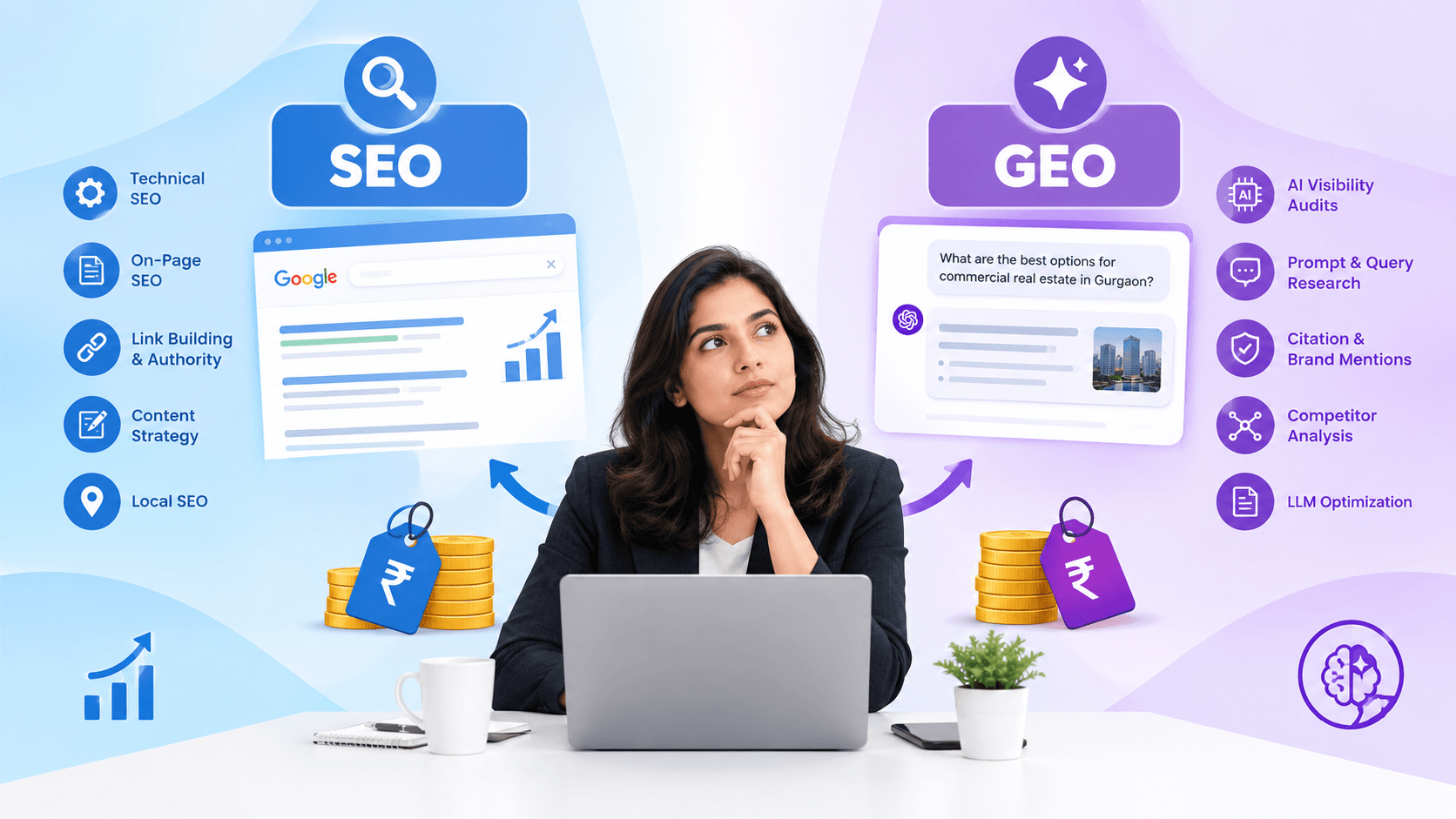
SEO and GEO are related but serve different optimization objectives.
What is SEO?
Search Engine Optimization (SEO) is the process of improving a website's visibility in traditional organic search results.
Its objective is to help search engines discover, understand, index and rank relevant website pages.
Traditional SEO includes:
- Keyword research and search intent.
- Technical SEO and website architecture.
- On-page optimization and metadata.
- Content marketing and topical authority.
- Internal linking and website structure.
- Backlinks and digital PR.
- Local SEO and Google Business Profile.
- Page speed and mobile experience.
- Structured data and schema markup.
- Organic traffic and conversion optimization.
For example, a digital marketing agency targeting "best SEO agency in India" wants to improve its position in Google's organic results and attract potential customers.
What is GEO?
Generative Engine Optimization (GEO) is the practice of improving a brand's visibility, representation and citation potential within AI-generated answers.
Instead of focusing exclusively on website rankings, GEO considers how AI systems discover information, understand brands, retrieve relevant content and generate recommendations.
GEO techniques include:
- Entity SEO and consistent brand identity.
- AI-friendly content architecture.
- Question-based and conversational content.
- Authoritative third-party brand mentions.
- Original research and industry insights.
- Structured information and contextual relationships.
- Relevant digital PR and citations.
- AI visibility and prompt tracking.
- Brand sentiment and recommendation monitoring.
For example, a business wants to be included when someone asks ChatGPT:
"Which agencies in India specialize in Generative Engine Optimization and ChatGPT visibility?"
The goal is to strengthen the brand's digital footprint so that AI systems can understand and potentially reference it.
Importantly, GEO does not guarantee that an AI platform will recommend a particular business. Recommendations depend on the platform, query, available sources and retrieval processes.
3. SEO vs GEO: Technical Comparison
Area | Traditional SEO | GEO Optimization |
Primary objective | Organic rankings | AI mentions and citations |
Platforms | Google, Bing | ChatGPT, Gemini, Perplexity, Claude |
Research | Keywords and search intent | Prompts, questions and entities |
Content | Search-optimized pages | Answer-ready authoritative content |
Authority | Backlinks and website reputation | Multi-source brand credibility |
Technical focus | Crawling and indexing | Retrieval accessibility and clarity |
Measurement | Rankings, clicks and traffic | Mentions, citations and AI referrals |
Conversion | Organic leads and sales | AI-influenced leads and sales |
SEO and GEO should not be treated as competing marketing disciplines. They are complementary parts of a unified search strategy.
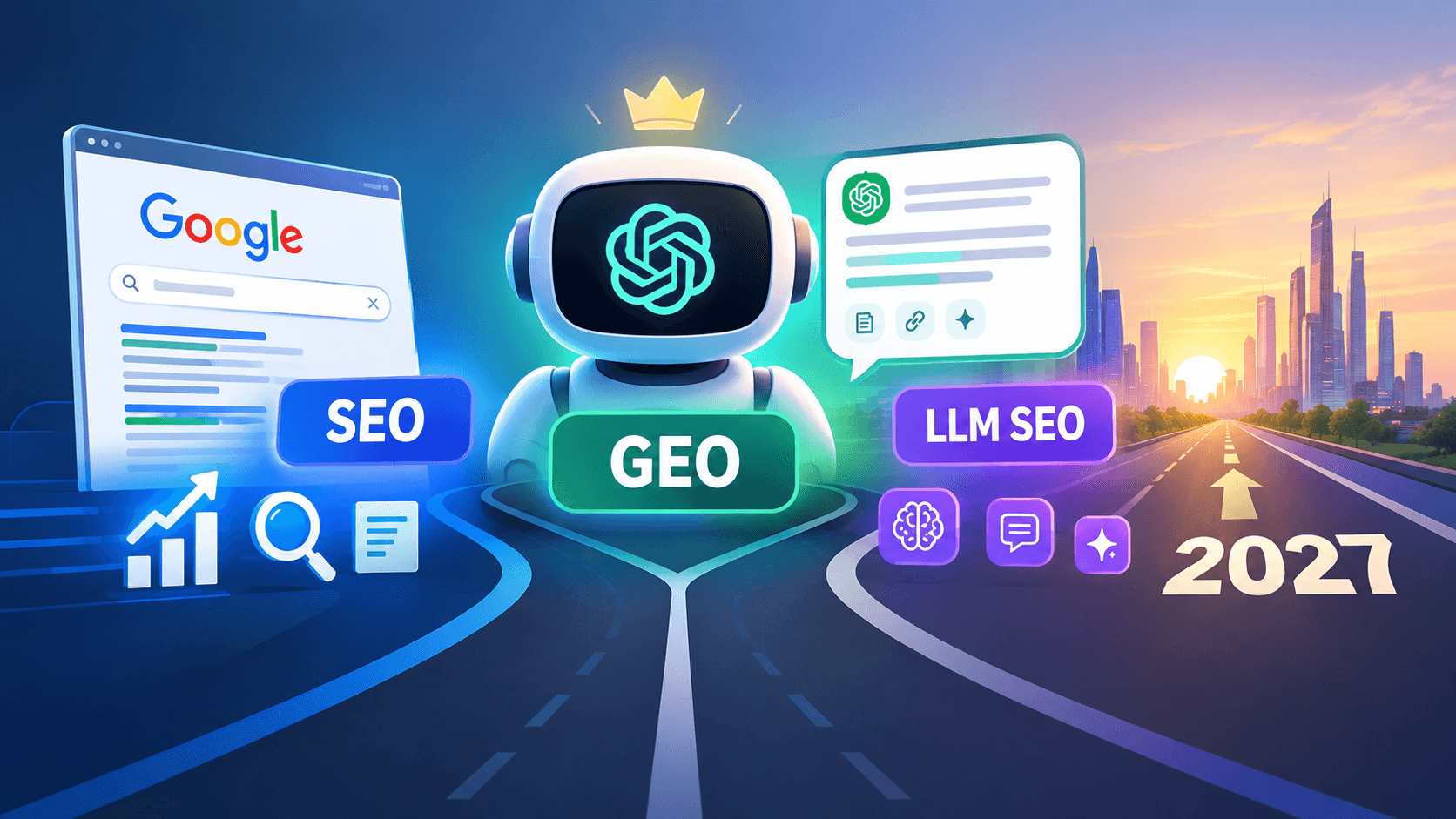
4. Google SEO vs LLM SEO: How Are They Different?
A common misconception is that ranking on Google automatically guarantees visibility in ChatGPT.
That is not necessarily true.
Google and large language model-powered search experiences can use different indexes, retrieval systems, ranking processes and information sources.
Google SEO
Google SEO focuses on improving website accessibility, relevance, quality and authority.
The process involves:
- Google discovers website pages through crawling.
- Its systems process and index eligible content.
- Ranking systems evaluate relevance and quality.
- Search results are generated for specific queries.
- Users click through to relevant websites.
Google AI Overviews and AI Mode also use Google's search ecosystem. Google continues to recommend established SEO best practices for these experiences.
LLM SEO
LLM SEO focuses on helping AI-powered systems discover and accurately understand a brand and its expertise.
Depending on the platform, an AI assistant may use trained knowledge, live web search, retrieval systems or a combination of these.
A successful LLM optimization strategy should focus on:
- Consistent business and entity information.
- Clear service descriptions.
- Question-led content and direct answers.
- Strong topical relevance.
- Original research and verifiable facts.
- Authoritative external references.
- Accessible and well-structured website pages.
- Relevant brand mentions across trusted sources.
For example, when someone asks ChatGPT to recommend an industrial scrap marketplace, a brand's website content, marketplace listings, external references and business information may contribute to its discoverability.
A brand mention is not the same as a website citation, and neither automatically proves a lead conversion. Both should be measured separately.
5. Kabadi24: A Real-World Example of AI Search and GEO Opportunities
One practical example of how structured information can support the future of AI search is Kabadi24.com, an AI-search-enabled B2B industrial scrap marketplace.
Unlike conventional classified websites, Kabadi24 is designed to connect bulk industrial scrap buyers and sellers across India.
The platform publishes structured business requirements containing information such as:
- Material or product name.
- Required or available quantity.
- Buyer or seller intent.
- City and state.
- Material grade and specifications.
- Expected price or quotation requirements.
- Supply frequency and transportation conditions.
This structure is particularly valuable for search discovery because every listing describes a specific commercial requirement.
Real buyer and seller enquiries from Kabadi24
The Kabadi24 marketplace dashboard provides practical examples of live business requirements across different Indian markets.
Some anonymized examples include:
Material | Quantity | Location | Requirement |
HMS 1 scrap | 70 tonnes | Ahmedabad | Seller |
HMS 1 scrap | 100 tonnes | Indore | Seller |
Used copper scrap | 25 tonnes | Sambalpur | Buyer |
Copper scrap | 2 tonnes | Pune | Buyer |
Copper scrap | 1 tonne | Greater Noida | Buyer |
Copper 99.9 | 4 tonnes | Ahmedabad | Seller |
Industrial electronic machines | 1,000 kg | Delhi, Gurgaon and Punjab | Buyer |
Copper scrap | 50 kg | Bihar | Seller |
These examples illustrate how a marketplace can organize real commercial demand into searchable information.
Contact names, telephone numbers and email addresses are intentionally excluded to protect the privacy of buyers and sellers.
How can ChatGPT help discover these requirements?
Consider a potential buyer asking:
"Where can I find copper scrap sellers in India who can supply 2 tonnes in Pune?"
A well-structured marketplace listing can provide relevant information about the material, quantity and location.
If an AI search platform retrieves and references the relevant Kabadi24 listing, the marketplace can become a discovery point for that buyer.
The potential journey looks like this:
- A buyer asks an AI assistant for a specific scrap material.
- The AI platform searches or retrieves relevant information.
- A structured Kabadi24 listing becomes a potential source.
- The buyer visits the listing.
- The buyer submits an enquiry through the marketplace.
- Kabadi24 verifies and connects the relevant parties.
This illustrates how AI discovery and marketplace lead generation can work together.
An important distinction: The supplied dashboard proves that Kabadi24 has real buyer and seller enquiries. It does not establish that ChatGPT generated those particular enquiries. To demonstrate ChatGPT-attributed leads, the marketplace must separately record AI referral sources, UTM parameters or verified enquiry attribution.
Nevertheless, Kabadi24 demonstrates the business opportunity behind GEO: making structured commercial information accessible to the next generation of search and discovery platforms.
Explore the live marketplace: https://kabadi24.com/
6. How GEO Digital Helps Businesses Win AI Search
As search evolves, businesses need specialist strategies for visibility across conversational AI platforms.
GEO Digital focuses on Generative Engine Optimization, AI SEO and LLM optimization.
Its approach includes:
ChatGPT Optimization: Improving brand information, content structure and authority signals to increase discoverability in ChatGPT responses.
Gemini Optimization: Strengthening visibility across Google's AI-powered discovery ecosystem.
Perplexity Optimization: Improving the potential for credible citations in research-oriented AI answers.
Claude Optimization: Developing structured, authoritative information for AI-assisted research and professional discovery.
Entity Optimization: Building consistent relationships between brands, services, industries and topics.
AI Visibility Monitoring: Measuring mentions, citations, recommendation frequency and competitor visibility.
Explore GEO Digital's services:
- GEO and AI Search Optimization: https://geodigital.agency/
- Artificial Intelligence SEO: https://geodigital.agency/artificial-intelligence-seo
- ChatGPT Optimization: https://geodigital.agency/chatgpt-optimization
- GEO Digital Insights and Blog: https://geodigital.agency/blog
GEO Digital complements traditional SEO by focusing on how businesses can become discoverable in AI-generated answers.
7. The Role of Traditional SEO in the AI Search Era
Although AI search is growing, traditional SEO remains essential.
Google continues to be a major discovery platform, and technical accessibility, useful content, relevance and authority remain important foundations for online visibility.
SEO Marketing Agency™ brings together traditional search optimization and emerging AI search strategies.
Its services cover:
- Technical SEO.
- On-page and off-page SEO.
- B2B and enterprise SEO.
- Local and international SEO.
- Content marketing.
- Keyword and competitor research.
- Digital PR and link building.
- SEO audits and consulting.
- GEO, AEO and AI optimization.
The objective is to build sustainable search visibility that generates qualified traffic, leads and business growth.
Explore services: https://seomarketing.agency/services/seo-marketing
For additional insights, explore the SEO Marketing Agency blog:
https://seomarketing.agency/smm-blog/
Recommended related reading includes:
- Google AI Overviews Ranking Guide.
- AI SEO vs AEO: The Complete Citation Strategy Guide.
- Ultimate Guide to GEO Tools for Monitoring Citations and Visibility.
- Robots.txt vs LLMs.txt: Key Differences for AI SEO.
8. What Is the Future of Search in 2027?
The next phase of search is likely to become more conversational, personalized and multimodal.
Five major developments deserve attention.
1. AI assistants will become important discovery channels
Customers will increasingly use AI assistants to compare suppliers, identify service providers, research products and make decisions.
2. Search will become more conversational
Instead of entering short keywords, people will ask detailed questions that include their location, requirements, budget and preferences.
Businesses must develop content that answers these specific questions.
3. Zero-click search will change measurement
AI-generated answers may satisfy users without requiring website visits.
Brands will need to monitor citations, mentions, branded searches and assisted conversions alongside organic traffic.
4. Multimodal search will expand
Voice, images, video and text will increasingly work together.
Product information, visual content, video descriptions and structured data will become important components of digital discoverability.
5. Brand authority will become a competitive advantage
A company's website alone may not be enough to establish its reputation.
Independent references, credible publications, reviews, expert contributions and consistent business information will help strengthen its digital identity.
These are strategic expectations rather than guaranteed outcomes. Search platforms and user behaviour will continue to evolve.
9. How Businesses Should Prepare for 2027
Businesses should not abandon Google SEO to chase AI visibility.
Instead, they should implement a combined strategy:
- Traditional SEO for rankings and organic traffic.
- GEO for generative search visibility.
- LLM SEO for AI-powered discovery.
- AEO for direct answers and answer-engine experiences.
- Entity SEO for brand understanding.
- Digital PR for external credibility.
- Technical SEO for accessibility and indexing.
- AI visibility tracking for measurable performance.
For B2B businesses, structured product and service information is especially valuable.
For marketplaces, accurate buyer and seller requirements can create additional opportunities for search discovery.
For service businesses, strong service pages, original research, case studies and customer references can strengthen their online authority.
Conclusion: The Future Belongs to Brands That Become the Answer
Is ChatGPT winning the AI search war in 2026? It is one of the strongest competitors, but the AI search ecosystem remains competitive.
Is GEO replacing SEO? No. GEO expands traditional search optimization into AI-powered discovery.
Will Google SEO matter in 2027? Absolutely. But businesses must look beyond rankings and focus on visibility across the complete customer discovery journey.
The Kabadi24 example illustrates an important opportunity: when business requirements are organized into clear, relevant and searchable information, they can become more discoverable across traditional and AI-powered search experiences.
The future is not Google versus ChatGPT. It is a connected search ecosystem where traditional search engines, AI assistants, websites and marketplaces work together to help customers find what they need.
At SEO Marketing Agency™, we believe the next generation of digital growth will be driven by strong SEO foundations, intelligent GEO strategies, trusted brand authority and measurable business outcomes.
Don't just rank in search. Become the answer your customers trust.
Explore traditional SEO with https://seomarketing.agency/ and next-generation AI search optimization with https://geodigital.agency/.
For B2B scrap buyers and sellers, explore the live marketplace at https://kabadi24.com/.
Questions, answered
Frequently Asked Questions
1. What is the difference between SEO and GEO?
SEO improves website rankings and organic visibility on search engines like Google. GEO (Generative Engine Optimization) focuses on improving brand visibility, mentions and citations in AI-generated answers across platforms like ChatGPT, Gemini and Perplexity.
2. How does ChatGPT SEO work?
ChatGPT SEO focuses on making a brand's information easier for AI systems to discover, understand and reference. It involves authoritative content, entity optimization, structured information, relevant third-party mentions and a consistent digital presence.
3. Is GEO replacing traditional SEO in 2027?
No. GEO is not replacing traditional SEO. Businesses need both strategies to maintain Google rankings while improving visibility across AI-powered search platforms. Combining SEO, GEO and AEO creates a more comprehensive search strategy.
4. What is the difference between Google SEO and LLM SEO?
Google SEO focuses on crawling, indexing and ranking web pages in search results. LLM SEO focuses on helping large language model-powered platforms understand brand information, retrieve relevant content and potentially reference businesses in AI-generated responses.
5. How can businesses get their brands recommended by ChatGPT?
Businesses can improve their chances of appearing in ChatGPT responses by publishing authoritative content, maintaining consistent brand information, earning credible third-party mentions, strengthening topical authority and making website content accessible to search systems. However, no strategy guarantees recommendations.