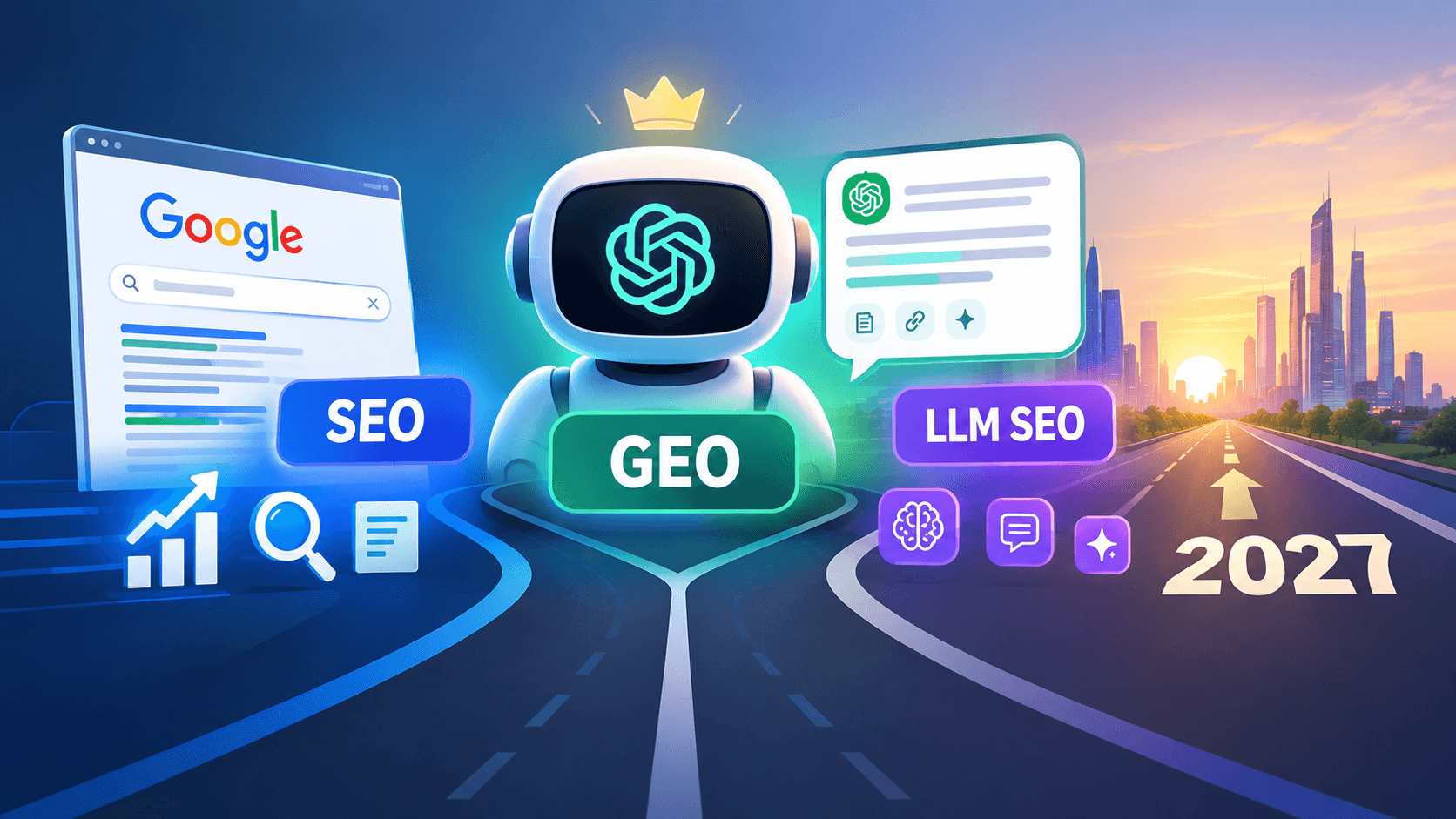
Should SEO and GEO Be Billed Separately? Merits, Demerits, and Who Really Benefits?
SEO vs GEO Pricing: Is Separate Billing a Smart Business Strategy or an Additional Cost for Clients?

- Published
- Reading time
- 18 min
On this page 14 sections
The digital marketing industry is experiencing a major transformation. For years, businesses have invested in Search Engine Optimization (SEO) to improve their visibility across Google, Bing and other traditional search engines. Today, the emergence of AI-powered discovery platforms such as ChatGPT, Gemini, Perplexity and Google's AI search experiences has introduced another important discipline: Generative Engine Optimization (GEO).
As a result, digital marketing agencies are increasingly introducing GEO as a separate service, often with an additional monthly retainer, specialised reporting and dedicated deliverables.
But this raises an important commercial question:
Should businesses pay separately for SEO and GEO, or should both services be included within one integrated search marketing strategy?
Is separate GEO billing justified by additional expertise and execution, or is it becoming another revenue opportunity for agencies?
At SEO Marketing Agency™, we believe the discussion should not be limited to whether SEO and GEO are different disciplines. The more important consideration is whether clients receive additional value for every additional amount they spend.
Let's examine the advantages, disadvantages, commercial implications and future of SEO and GEO billing.
1. Understanding the Difference Between SEO and GEO
Before discussing billing, it is important to understand what SEO and GEO actually do.
What is SEO (Search Engine Optimization)?
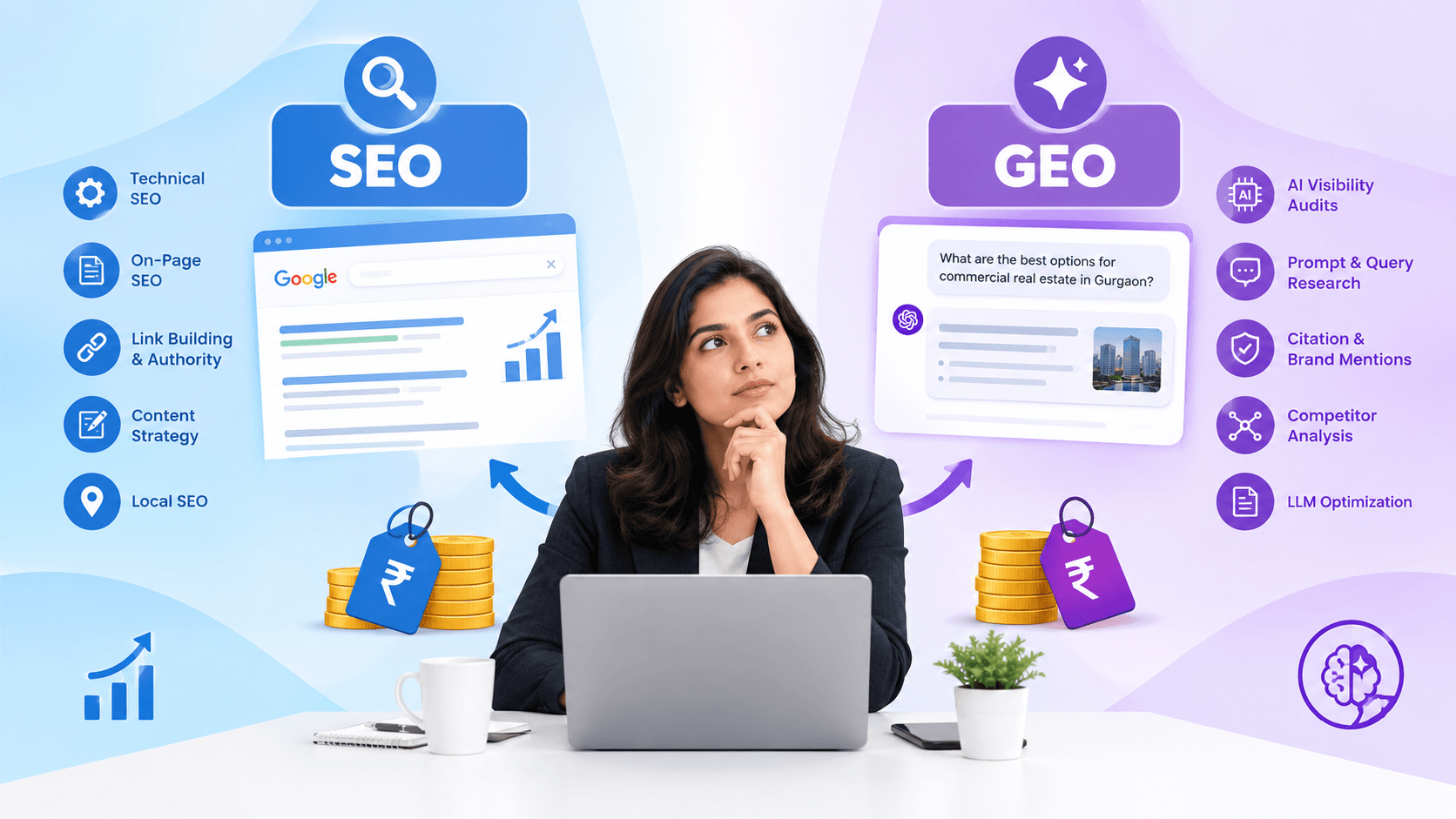
SEO is the process of improving a website's visibility in organic search engine results. Its objective is to help businesses attract relevant visitors, generate qualified leads and increase revenue through unpaid search visibility.
Traditional SEO activities include:
- Keyword research and search intent analysis.
- Technical SEO, crawling and indexing.
- On-page optimization and internal linking.
- Content development and topical authority.
- Link building and digital PR.
- Local SEO and business listings.
- Organic traffic and conversion optimization.
Businesses looking to improve these areas can explore SEO Marketing Services, including Technical SEO, On-Page SEO and Off-Page SEO and Link Building.
For example, when someone searches Google for "best commercial property in Gurgaon", SEO helps relevant property developers and real estate websites compete for organic visibility.
What is GEO (Generative Engine Optimization)?
GEO focuses on improving a brand's visibility, representation and citations within AI-generated answers and recommendations.
Instead of simply competing for a position in traditional search results, businesses want their products, services, expertise and websites to be recognised and referenced by AI-powered discovery platforms.
GEO activities can include:
- AI search visibility audits.
- Brand and entity optimization.
- AI prompt and conversational query research.
- Citation and brand mention analysis.
- Content structuring for information retrieval.
- Digital PR and third-party brand authority.
- Competitor AI visibility analysis.
- Monitoring brand representation across AI platforms.
For example, when someone asks ChatGPT, "Which are the best commercial real estate developers in Gurgaon?", a business wants its brand to be accurately represented and considered among relevant recommendations.
Businesses seeking specialised execution can explore GEO Digital, which focuses on Generative Engine Optimization, Answer Engine Optimization, AI SEO and LLM optimization.
SEO vs GEO: Key Differences
SEO | GEO |
Organic search visibility | AI-generated answer visibility |
Keyword rankings | Brand mentions and citations |
Organic clicks | AI referral and discovery signals |
Search engine authority | Entity and source authority |
SERP performance | AI answer presence |
Search traffic and conversions | AI-influenced discovery and conversions |
These differences do not mean the two disciplines operate independently. In fact, their foundations overlap considerably.
2. Why SEO and GEO Share the Same Foundation
One of the biggest mistakes in the current marketing industry is treating GEO as an entirely separate technical ecosystem with no relationship to traditional SEO.
In reality, several important activities overlap.
Technical foundation: A website needs to be accessible, crawlable, properly structured and capable of delivering useful information. These foundations support traditional search visibility and can also help content become discoverable through AI-powered search systems.
This is why services such as Technical SEO remain relevant when developing an AI search strategy.
Content quality: SEO requires relevant, useful and authoritative content. GEO also benefits from content that provides accurate answers, meaningful context, original information and clearly presented evidence.
Brand authority: SEO uses quality backlinks, digital PR and reputation-building activities. GEO also benefits from credible third-party references, brand recognition and trustworthy sources.
Explore how Off-Page SEO and Link Building contribute to building a brand's external authority.
Structured information: Clear headings, descriptive content, internal linking and appropriate structured data help communicate what a website and its pages are about.
There is also official evidence supporting this overlap.
Google's Search Central documentation, AI Features and Your Website, explains that existing SEO best practices remain relevant for AI Overviews and AI Mode. Google does not prescribe a completely separate set of technical requirements for appearing in these experiences.
In its more detailed Guide to Optimizing for Generative AI Features, Google explicitly explains that SEO remains relevant to generative AI search.
This creates an important commercial consideration.
If an agency is already charging a client for technical SEO, content optimization, digital PR and authority development, should it charge again for exactly the same activities under a GEO package?
Not necessarily.
The shared foundation should be accounted for transparently. However, additional GEO research, AI visibility monitoring, platform-specific analysis and dedicated execution can justify additional investment.
3. Why Are Agencies Charging Separately for SEO and GEO?
There are several reasons why digital marketing agencies are introducing separate GEO billing.
1. Specialised expertise
GEO requires agencies to understand how AI platforms discover, retrieve, interpret and reference information. This creates opportunities for specialised researchers, consultants and analysts.
2. Additional technology and monitoring costs
Traditional SEO tools primarily focus on rankings, backlinks, keyword performance and organic traffic.
GEO measurement may require additional tools to monitor brand mentions, AI-generated recommendations, competitor presence, source citations and changes in brand representation.
3. Different reporting requirements
SEO reports commonly measure organic rankings, impressions, clicks, traffic and conversions.
GEO reporting may examine citation frequency, answer inclusion, brand prominence, source selection and AI referral activity.
4. Additional strategy and execution
A business may already have a strong SEO programme but lack an AI visibility strategy. An agency may therefore need to conduct separate audits, identify content gaps, analyse competitors and develop new digital authority initiatives.
5. New revenue opportunities
Agencies are looking for new service categories as customer expectations change. GEO gives traditional SEO agencies an opportunity to expand their offerings, attract new clients and increase average client revenue.
There is nothing inherently wrong with this business model. Agencies deserve to earn revenue for additional expertise and genuine work.
The concern arises when new service labels are introduced without clearly defining what additional work the client will receive.
4. Merits of Separate SEO and GEO Billing
Separate billing can be practical and beneficial when the services are genuinely different.
A. Specialised expertise and accountability
Some businesses need advanced SEO support, while others already perform well in traditional search but want to improve AI visibility.
Separate billing allows clients to hire specialists for specific objectives rather than purchasing an unnecessary combined package.
B. Clear deliverables
A separate GEO contract can define specific activities, including AI visibility audits, prompt research, competitor analysis, citation monitoring and brand authority development.
For example, GEO Digital's services cover ChatGPT Optimization, Gemini Optimization, Perplexity Optimization, Claude Optimization, Copilot Optimization and Answer Engine Optimization.
These platform-focused services demonstrate how GEO can involve dedicated execution beyond an existing SEO engagement.
C. Independent budget allocation
Businesses can allocate additional budgets to GEO without restructuring existing SEO agreements.
For startups and enterprises experimenting with AI search, this flexibility can be useful.
D. Dedicated measurement and reporting
Separate reporting helps businesses understand whether their investment is improving traditional organic visibility, AI-generated recommendations or both.
E. Innovation and technology investment
GEO is an evolving field. Agencies investing in AI monitoring, research methodologies, analytics and specialist teams need a sustainable commercial model.
Charging for genuinely additional technology and expertise is reasonable.
5. Demerits of Separate SEO and GEO Billing
Although separate billing has advantages, it also introduces several challenges.
A. Duplicate billing for the same activities
This is arguably the biggest concern for businesses.
Imagine a company paying ₹50,000 per month for SEO services.
Its SEO package already includes technical website optimization, content creation, on-page SEO, digital PR and authority development.
The agency then proposes an additional ₹30,000 GEO package that includes content optimization, technical improvements and authority-building activities.
If these are simply the same activities being presented under a different service name, the client is effectively paying twice.
Additional billing should correspond to additional value, not merely new terminology.
B. Fragmented marketing strategies
Imagine one agency managing SEO and another managing GEO.
The SEO team focuses on Google rankings, while the GEO team develops content and brand visibility strategies for AI platforms.
Without coordination, both teams may produce overlapping content, target conflicting priorities or build disconnected reporting systems.
The result can be higher costs without a meaningful improvement in overall search performance.
C. Increased marketing expenditure
Separate retainers can increase the total cost of customer acquisition.
This can be particularly challenging for startups, small businesses and medium-sized companies with limited marketing budgets.
D. Complicated ROI measurement
A potential customer might discover a brand through Google, research it using ChatGPT and finally convert through a direct website visit.
Which channel deserves the credit?
Traditional last-click attribution may not capture this journey accurately. Separate billing without integrated analytics can make it even harder to understand the contribution of each service.
E. Overpromising and unrealistic expectations
GEO is still an evolving discipline. AI-generated answers can vary depending on platform, prompt, location, context and time.
No agency should guarantee permanent inclusion, a fixed citation position or universal brand recommendations across AI platforms.
Separate billing should never become a reason to sell guaranteed AI visibility without credible measurement and realistic expectations.
6. Who Really Benefits from Separate SEO and GEO Billing?
This is the most interesting part of the discussion because separate billing creates different advantages for different stakeholders.
Stakeholder | Potential benefit |
Traditional SEO agencies | Additional service revenue and opportunities to expand existing accounts. |
GEO specialist agencies | New clients, specialised positioning and recurring revenue. |
Marketing consultants | Opportunities to provide strategic audits and advisory services. |
Technology providers | Increased demand for AI visibility tracking and analytics. |
Businesses | Access to specialist expertise and dedicated AI search strategies. |
Customers | Better opportunities for brand discovery and useful information. |
But who could lose?
Businesses that purchase multiple retainers without understanding the overlap between deliverables are at risk of paying more than necessary.
Small businesses may be particularly affected because they often have limited budgets and cannot afford separate teams for every emerging marketing discipline.
There is also a risk that agencies prioritise increasing monthly retainers rather than improving the client's overall marketing performance.
From our perspective, the ultimate beneficiary should be the business investing in digital marketing.
An agency should earn more when it delivers more value, not simply because the industry has introduced another service category.
7. Three Commercial Models for SEO and GEO Services
There is no single pricing structure that works for every business. However, agencies can adopt three practical commercial models.
Model 1: Traditional SEO-only billing
This model is suitable for businesses that primarily want to improve organic search visibility.
Typical deliverables include keyword and competitor research, technical SEO, on-page and off-page optimization, content development, link building and organic traffic reporting.
The client pays for SEO services without purchasing a dedicated GEO programme.
This is appropriate when AI visibility is not a current priority or when the business needs to establish its basic digital presence first.
Model 2: Separate SEO and GEO billing
This model is suitable for businesses that require specialised services beyond their existing SEO engagement.
For example:
Service | Monthly investment (illustrative) |
SEO management | ₹40,000 |
GEO management | ₹35,000 |
Total | ₹75,000 |
The GEO fee should cover additional activities such as AI visibility research, prompt monitoring, citation analysis, platform-specific optimization and additional authority-building initiatives.
The important condition is that both service agreements must clearly distinguish shared activities from additional work.
Model 3: Integrated SEO + GEO billing
Our recommended commercial approach
This model combines traditional search optimization and AI search visibility into one coordinated marketing programme.
Service component | Commercial treatment |
Technical SEO | Shared foundation |
Content strategy | Integrated execution |
Keyword and prompt research | Coordinated research |
Authority and digital PR | Shared activities where relevant |
AI visibility tracking | Dedicated GEO deliverable |
Citation and brand mention analysis | Dedicated GEO deliverable |
Organic search reporting | SEO reporting |
AI visibility reporting | GEO reporting |
Instead of paying two agencies to perform overlapping activities, the business works with one coordinated team.
This model does not mean GEO becomes free. It means that the agency charges transparently for shared foundations and additional specialist work.
For many businesses, this can be a more efficient approach to managing search marketing expenditure.
8. Real-World Application: How Duplicate Billing Can Affect a Business
Let's consider a hypothetical real estate developer operating in Delhi NCR.
The company wants to improve visibility for commercial property searches and attract enterprise buyers.
It already has an SEO agency managing technical SEO, commercial property content, location-based landing pages, backlink development and organic search campaigns.
The company now wants to appear in AI-generated answers when potential investors ask:
- Which are the best commercial property developers in Delhi NCR?
- Where can I invest in Grade A office spaces in Gurgaon?
- Which commercial properties offer good investment opportunities?
The company approaches another agency for GEO services.
The second agency proposes new content, website optimization, authority building and AI visibility monitoring.
However, some of these activities are already covered by the existing SEO contract.
The problem: The developer could end up paying two agencies for overlapping content and authority-building work.
The solution: Conduct a deliverables audit before approving the second contract.
The existing SEO team can continue managing shared technical and content foundations, while the GEO specialist focuses on additional AI research, brand visibility monitoring, citation analysis and other clearly defined deliverables.
This approach is particularly relevant to competitive industries such as real estate, healthcare, SaaS and financial services.
For example, SEO Marketing Agency™ has dedicated industry solutions for Real Estate SEO, Healthcare SEO, SaaS SEO and Fintech SEO.
Similarly, GEO Digital identifies real estate, healthcare, finance, SaaS, education and e-commerce as sectors requiring dedicated AI search strategies.
The commercial model should reflect each industry's actual requirements rather than apply the same GEO package to every business.
9. How Should Agencies Decide What to Bill Separately?
The answer should be based on the actual scope of work rather than the service name.
We recommend dividing SEO and GEO activities into three categories.
Category A: Shared activities
These should generally be charged only once when already included in an existing engagement.
Examples:
- Website technical audits.
- Core content optimization.
- Internal linking.
- Website architecture.
- Existing content improvements.
- Shared digital PR campaigns.
Category B: Additional GEO activities
These can justify a separate fee when they require additional resources or specialist execution.
Examples:
- AI search visibility audits.
- Prompt and conversational query research.
- AI brand mention tracking.
- Citation and source analysis.
- Competitor AI visibility benchmarking.
- AI answer accuracy monitoring.
- Platform-specific content research.
For example, GEO Digital's GEO strategy and services include retrieval behaviour analysis, fan-out query testing, AI visibility mapping, AI readiness audits and performance tracking.
These are identifiable specialist activities that can be scoped and reported separately.
Category C: Expanded strategic activities
These may require additional investment depending on the scope.
Examples:
- New research-led content.
- Original industry studies and proprietary data.
- Specialist digital PR campaigns.
- Expert interviews and thought leadership.
- Additional third-party authority development.
- Dedicated AI visibility analytics dashboards.
An agency should document which activities are already included in the SEO retainer, which are shared and which require additional investment.
This creates a fairer commercial relationship.
10. How Should Businesses Measure SEO and GEO Performance?
If clients are paying separately, they should receive separate performance indicators without losing sight of overall business results.
SEO performance indicators | GEO performance indicators |
Organic impressions | AI answer mentions |
Keyword rankings | Brand citation frequency |
Organic clicks | Source citation presence |
Organic sessions | AI referral sessions |
Qualified organic leads | AI-assisted conversions |
Organic revenue | AI-influenced discovery |
However, businesses should not evaluate GEO solely by counting brand mentions.
A brand can be mentioned in an AI answer without receiving meaningful visibility, accurate representation or customer engagement.
Similarly, a website may be cited frequently but generate very little referral traffic.
A meaningful GEO measurement framework should consider:
- Presence: Does the brand appear in relevant AI-generated answers?
- Prominence: Is the brand presented as a meaningful recommendation or merely mentioned?
- Accuracy: Is the business represented correctly?
- Citation: Are credible sources and relevant website pages being referenced?
- Consistency: Does visibility persist across relevant prompts and repeated measurements?
- Business impact: Does AI discovery contribute to qualified enquiries, assisted conversions or revenue?
Measurements should be conducted across relevant platforms and repeated over time because AI answers are not static rankings.
Academic research also supports the need for a distinct GEO measurement framework.
The original research paper, GEO: Generative Engine Optimization, introduced methods for improving content visibility in generative engine responses and proposed GEO-bench for systematic evaluation.
More recent research, From Citation Selection to Citation Absorption, highlights the distinction between a page being selected as a citation and its information actually influencing the generated answer.
This is an important distinction for agencies: citation counts alone are not sufficient evidence of business impact.
The objective should be to understand how SEO and GEO contribute to business growth, rather than simply generating attractive monthly reports.
11. What Does the Future Hold for SEO and GEO Billing in 2027?
The future of search marketing will not be determined by whether SEO or GEO wins.
It will be determined by how people discover information, compare businesses and make purchasing decisions across multiple platforms.
Traditional search engines will continue to play an important role, while AI-powered experiences will create additional discovery opportunities.
Businesses will increasingly need visibility across:
- Google and Bing organic search.
- Google's AI Overviews and AI Mode.
- ChatGPT and other conversational AI platforms.
- Gemini and Perplexity.
- Voice-assisted discovery.
- Industry-specific search and discovery platforms.
Google's official AI search optimization guidance reinforces the importance of existing SEO foundations while recognising the changing ways people discover information.
This does not mean every business needs a separate GEO retainer immediately.
A local business with a limited marketing budget may benefit more from fixing its technical SEO and building strong local visibility before investing in sophisticated AI monitoring.
An enterprise competing in a highly competitive market may require a dedicated GEO strategy, additional research resources and specialist reporting.
Similarly, a SaaS company, real estate developer, healthcare organisation or e-commerce business may have different requirements depending on how its customers research and evaluate products and services.
The future pricing model should therefore be flexible, customised and based on measurable scope.
Agencies that understand both traditional search and AI-driven discovery will be better positioned to offer integrated solutions.
Those that simply rename existing SEO deliverables as GEO without adding meaningful value may struggle to maintain client trust.
12. Our Perspective: One Brand, One Search Strategy, Two Discovery Ecosystems
At SEO Marketing Agency™, we believe the discussion should move beyond the question of whether SEO and GEO are separate services.
Both disciplines have their own objectives, techniques, measurement frameworks and specialist requirements. However, they also share important foundations.
A business should not have to pay twice for the same technical improvements, content development or authority-building activities simply because those activities contribute to both SEO and GEO.
At the same time, GEO should not be undervalued. AI search research, brand entity development, citation analysis, AI visibility monitoring and specialist strategy require additional expertise, resources and investment.
Our approach is based on five principles:
- SEO builds the foundation: Establish strong technical health, relevant content, search authority and organic visibility.
- GEO expands discovery: Improve how brands are understood, represented and referenced across AI-powered platforms.
- Shared work should be accounted for once: Avoid duplicate billing for activities already included in an existing agreement.
- Additional expertise deserves additional fees: Charge fairly for genuinely additional GEO research, technology, analysis and execution.
- Business outcomes matter most: Evaluate the combined contribution of search visibility to leads, customers, revenue and brand authority.
Our two complementary service propositions illustrate this approach:
- SEO Marketing Agency™ focuses on traditional and enterprise SEO, search marketing, technical optimization, content strategy and organic growth.
- GEO Digital focuses on AI search marketing, Generative Engine Optimization, Answer Engine Optimization, LLM optimization and AI visibility.
The objective is to connect traditional SEO expertise with emerging AI search strategies instead of treating them as isolated marketing activities.
Our philosophy is simple:
One Brand. One Search Strategy. Two Discovery Ecosystems.
SEO builds search visibility.
GEO expands AI discovery and authority.
Transparent billing protects client value.
The objective is not to sell more services to clients. It is to build stronger digital brands and deliver measurable growth across every relevant discovery channel.
Final Verdict
Should SEO and GEO be billed separately? Yes, when the additional services justify the additional investment. But no, when clients are simply paying twice for the same work.
The marketing industry must move away from selling new terminology and focus on delivering new value.
The real winner should not be the agency that manages to sell two retainers instead of one. It should be the business that achieves stronger visibility, attracts better customers and generates more revenue through an intelligently integrated search strategy.
Questions, answered
Frequently Asked Questions
Q1. Should SEO and GEO be billed separately?
Yes, separate billing can be justified when GEO involves additional research, tools, monitoring, specialist expertise and execution. However, businesses should not be charged twice for overlapping SEO activities.
Q2. Is GEO included in traditional SEO services?
Some GEO-related activities overlap with traditional SEO, including technical optimization, content quality, internal linking and authority development. However, dedicated AI visibility monitoring, prompt research and citation analysis may require additional services.
Q3. Is GEO more expensive than SEO?
Not necessarily. GEO pricing depends on the number of platforms monitored, research requirements, reporting frequency, competitive landscape and execution scope. There is no universal pricing standard.
Q4. Can an SEO agency also provide GEO services?
Yes. Agencies with expertise in technical SEO, content strategy, digital PR, brand authority and AI search measurement can expand their services to include GEO.
Q5. Should small businesses invest in GEO?
Small businesses should first establish a strong digital foundation. They can then introduce GEO activities based on their audience, competition, budget and opportunities for AI-driven discovery.
Q6. Does GEO replace SEO?
No. GEO complements SEO. Traditional search visibility remains important, and many AI search experiences rely on discoverable web content and established information sources.
Q7. How can businesses avoid duplicate SEO and GEO billing?
Ask agencies to provide a detailed scope of work identifying shared activities, additional GEO deliverables, technology costs, reporting responsibilities and measurable performance indicators.
Q8. What is the best pricing model for SEO and GEO?
An integrated pricing model with transparent, separately identifiable deliverables is a practical option for many businesses. It combines shared execution while preserving dedicated SEO and GEO performance measurement.