What Is Search Intent? A Complete Guide to Understanding User Intent
Search intent is one of the most important concepts in modern SEO.

- Published
- Updated
- Reading time
- 13 min
On this page 33 sections
You can target a keyword with strong search volume and create well-written content, but if your page does not match what the user actually wants, it may struggle to perform.
That is where search intent comes in.
Search intent, also known as user intent or keyword intent, is the reason behind a person's search query. It helps explain what the user is trying to find, learn, compare or accomplish.
For example, someone searching for “what is SEO” is probably looking for an explanation. Someone searching for “best SEO agency” may be comparing providers. A person searching for “SEO services” may be closer to hiring an agency.
Understanding these differences helps businesses create the right content for the right audience at the right stage of their journey.
If you are new to search engine optimization, start with our guide, What Is SEO? A Complete Guide to Search Engine Optimization, to understand how SEO and organic search work.
What Is Search Intent?
Search intent is the purpose behind a search query.
When a person enters words into Google or another search platform, they usually have a specific goal. They may want to:
- Find information
- Visit a particular website
- Compare products or services
- Make a purchase
- Contact a business
- Solve a specific problem
The words in a keyword can provide clues about that goal, but the full context matters.
For example, the keyword “SEO” is broad. A person searching for it could want a definition, a course, software or professional services.
In comparison, “how to do keyword research for SEO” clearly suggests an informational goal. “SEO services for businesses” has stronger commercial or transactional intent.
Understanding the user's goal helps you decide whether the best page should be a blog post, guide, comparison page, product page or service page.
Google's guidance emphasizes creating helpful, people-first content that satisfies the needs of users rather than creating pages primarily to manipulate search rankings.
Why Is Search Intent Important for SEO?
Search engines aim to provide useful results for a user's query.
This means SEO is not only about placing keywords in titles and headings. You also need to understand what the searcher expects to find.
Matching search intent can help you:
- Create more relevant content
- Improve the user experience
- Reduce the gap between a search query and your content
- Choose the right content format
- Build a more effective keyword strategy
- Connect informational content with relevant commercial pages
For example, a person searching for “what is technical SEO” may want an educational guide.
A person searching for “technical SEO services” is more likely to be looking for professional support. In this case, a relevant Technical SEO Services page may better match the user's intent.
The key is simple: create the page that best helps the user achieve their goal.
The Four Main Types of Search Intent
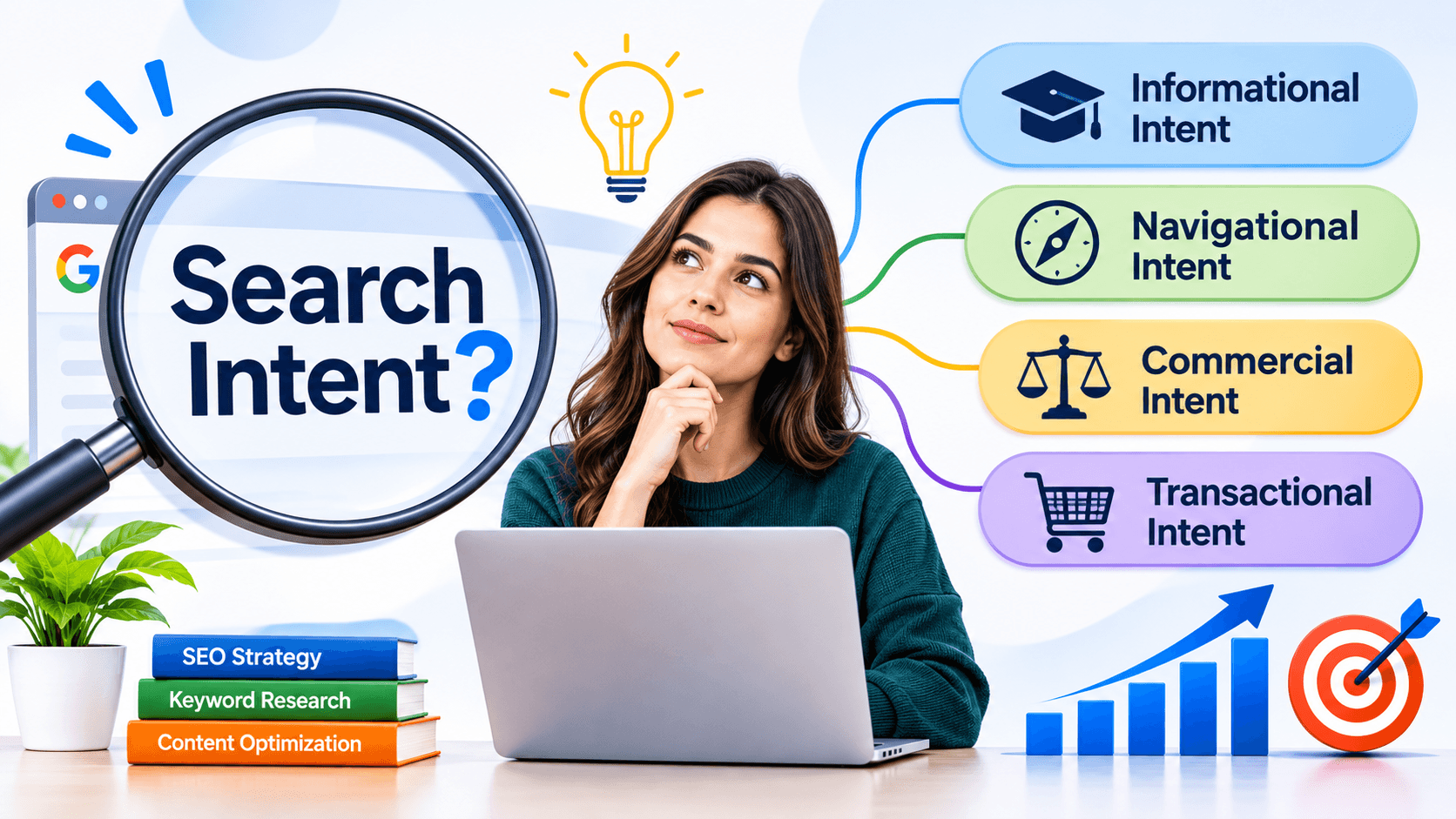
Search intent is commonly grouped into four major categories.
1. Informational Intent
Informational searches happen when a user wants to learn something or find an answer.
Examples include:
- What is SEO?
- How does keyword research work?
- What is search intent?
- How to improve website rankings
- What is technical SEO?
Users with informational intent are usually looking for educational content.
The best content formats may include:
- Blog posts
- Complete guides
- Tutorials
- How-to articles
- FAQs
- Research and educational resources
For example, our guide on How to Do Keyword Research for SEO is designed to help users understand and implement a keyword research process.
How to Optimize for Informational Intent
Focus on answering the user's question clearly.
A strong informational page should:
- Explain the topic early
- Use clear headings
- Cover important related questions
- Include useful examples
- Link to relevant supporting resources
Google recommends creating useful, original content that is easy to read and well organized.
2. Navigational Intent
Navigational searches happen when a user wants to find a particular website, brand or destination.
Examples include:
- SEO Marketing Agency
- Google Search Console
- GEO Digital
- OpenAI
- LinkedIn login
The searcher usually knows where they want to go.
For businesses, navigational intent highlights the importance of building a recognizable brand and making important pages easy to find.
How to Optimize for Navigational Intent
Businesses should ensure that:
- Their brand name is used consistently
- Important pages have clear titles
- Website navigation is simple
- Brand information is accurate
- Key pages can be easily discovered
Strong internal linking can also help users and search engines understand the relationships between important pages on a website. Google notes that links help connect users and search engines to relevant pages and resources.
3. Commercial Investigation Intent
Commercial investigation occurs when a user is researching options before making a decision.
Examples include:
- Best SEO tools
- Best SEO agencies
- SEO vs PPC
- Ahrefs vs Semrush
- Best technical SEO agency
The user may not be ready to buy immediately, but they are actively evaluating choices.
The best content formats may include:
- Comparison articles
- Buying guides
- Service comparisons
- Case studies
- Feature comparisons
- Reviews
How to Optimize for Commercial Investigation
Provide useful information that helps the user make an informed decision.
Consider including:
- Key features or services
- Relevant comparisons
- Use cases
- Evidence and examples
- Clear next steps
Avoid creating content that only promotes your business without helping the reader evaluate their options.
4. Transactional Intent
Transactional intent occurs when a user is ready to take action.
Examples include:
- Hire an SEO agency
- SEO services
- Technical SEO consultant
- SEO audit service
The best page for these queries is often a service or conversion-focused landing page.
For businesses looking for professional search optimization support, your content can naturally direct relevant users to your SEO Services.
How to Optimize for Transactional Intent
A transactional page should clearly explain:
- What service or product is offered
- Who it is designed for
- The benefits and scope of the solution
- Relevant expertise or experience
- How the user can take the next step
Do not try to force a detailed educational article to rank for a strongly transactional keyword if a service page is what the user is likely looking for.
Search Intent Examples
The following table shows how the same general topic can have different search intents.
Search Query | Likely Intent | Best Content Type |
What is SEO? | Informational | Complete guide |
How to do keyword research | Informational | Step-by-step tutorial |
SEO Marketing Agency | Navigational | Homepage or brand page |
Best SEO agencies | Commercial investigation | Comparison or research guide |
SEO services | Transactional | Service page |
Technical SEO services | Transactional | Technical SEO service page |
The lesson is important: keywords alone do not determine the right page. The user's goal helps determine the right content.
How to Identify Search Intent
Understanding search intent requires more than looking at a keyword in isolation.
Here are five practical ways to identify it.
Step 1: Look at the Words in the Search Query
Certain words can provide useful clues.
Informational Modifiers
- What
- How
- Why
- Guide
- Tutorial
- Tips
Commercial Modifiers
- Best
- Top
- Compare
- Review
- Vs
Transactional Modifiers
- Buy
- Hire
- Services
- Agency
- Pricing
These modifiers are helpful signals, but they are not always enough on their own.
Step 2: Analyze the Search Results
One of the best ways to understand search intent is to examine the pages currently appearing for the query.
Ask:
- Are the top results blogs or service pages?
- Are users being shown comparison content?
- Are the ranking pages primarily educational?
- What content format appears most often?
For example, if the results are dominated by detailed guides, creating a short sales page may not be the best way to match the searcher's intent.
Analyze the results to understand what users are likely expecting, then look for ways to provide additional value rather than simply copying competitors.
Step 3: Review Related Questions
Related searches and common questions can reveal what users want to know about a topic.
For example, someone researching keyword research may also want answers to:
- What is a keyword?
- How do I find low-competition keywords?
- What is search volume?
- How do I identify keyword intent?
These questions can help you create more comprehensive and useful content.
However, only include questions that are genuinely relevant to the primary topic.
Step 4: Consider the Customer Journey
Search intent can change as a user moves through the decision-making process.
For example:
Awareness
“What is SEO?”
↓
Research
“How does SEO work?”
↓
Evaluation
“Best SEO agency”
↓
Action
“SEO services”
A strong content strategy can support users at different stages of this journey.
This is why informational blogs and commercial service pages should work together rather than compete with each other.
Step 5: Match the Intent to the Right Page
Once you understand the user's goal, choose the best content format.
Intent | Recommended Page |
Learn | Blog or guide |
Find a brand | Homepage or brand page |
Compare options | Comparison guide |
Buy or hire | Product or service page |
This process can prevent keyword cannibalization, where multiple pages compete for similar topics without a clear purpose.
How Search Intent Supports Keyword Research
Keyword research and search intent should work together.
Keyword research helps you discover what people are searching for.
Search intent helps you understand why they are searching.
Both are necessary for an effective SEO strategy.
For a complete keyword research process, including seed keywords, competition analysis and keyword mapping, read our How to Do Keyword Research for SEO: Complete Step-by-Step Guide.
A simple keyword research process can look like this:
Find the Keyword → Understand the Intent → Analyze the Results → Create the Right Page → Measure Performance
This approach helps turn keyword data into useful content rather than simply creating pages around search volume.
How to Optimize Content for Search Intent
Once you understand the intent behind a keyword, optimize your page to meet the user's expectations.
Start With a Clear Answer
For informational queries, answer the main question early.
A user searching “what is search intent?” should not need to read several paragraphs before finding a clear explanation.
Use the Right Content Format
Match your content to the likely purpose of the search.
For example:
- Guides for educational queries
- Comparisons for evaluation queries
- Service pages for commercial action
Cover Relevant Subtopics
A comprehensive page should answer important related questions without adding unnecessary or unrelated information.
Make Content Easy to Navigate
Use clear headings, short paragraphs and logical sections.
Google's SEO guidance recommends content that is easy to read, well organized and genuinely useful to users.
Create Relevant Internal Links
Internal links can help users move from one relevant topic to another.
For example, after learning about keyword intent, a reader may want to understand how to use keywords within a webpage. In that case, our Complete Guide to On-Page SEO provides the next step.
For website accessibility, crawling and technical optimization, readers can also explore our Technical SEO Audit Checklist.
Search Intent and On-Page SEO
Search intent should influence how you optimize a page.
Before adding keywords to titles, headings and content, ask:
Does this page actually solve the problem behind the search query?
For example, if someone searches for “how to optimize title tags,” a useful page should provide practical steps and examples.
Simply creating a page that repeats the phrase “optimize title tags” without answering the question does not create a strong user experience.
Once you understand the correct topic and intent, on-page SEO helps communicate the content clearly through elements such as:
- Page titles
- Headings
- Content structure
- Internal links
- Images and descriptive text
Learn more about implementing these elements in our Complete Guide to On-Page SEO.
Search Intent and Technical SEO
Content quality and search intent are essential, but users and search engines also need to access your pages effectively.
Technical SEO can help address areas such as:
- Crawling
- Indexing
- Website structure
- Redirects
- Canonicalization
- Page performance
A technically healthy website supports the delivery and discovery of useful content.
Businesses can explore our Technical SEO Services for professional technical optimization support or use our Technical SEO Audit Checklist as a starting point for reviewing common issues.
Search Intent in AI-Powered Search
Search behavior is continuing to evolve.
Traditional keyword research remains important, but people increasingly use conversational and detailed questions when interacting with AI-powered search experiences.
This makes understanding user intent even more important.
Instead of focusing only on individual keywords, businesses should also consider:
- The question behind the query
- The user's broader goal
- Related entities and topics
- Clear and direct answers
- Original expertise and evidence
Google's guidance on helpful content emphasizes creating information that genuinely benefits people, demonstrates useful expertise and provides a satisfying experience.
For businesses exploring visibility across AI-powered search, Generative Engine Optimization and LLM platforms, visit GEO Digital.
The strongest strategy is not to choose between traditional SEO and emerging AI Search. Instead, create useful, authoritative content that helps real users while building a strong technical and topical foundation.
Common Search Intent Mistakes to Avoid
1. Targeting Keywords Without Understanding the User
A keyword can have strong search volume but still be irrelevant to your content or business.
Always ask what the user actually wants.
2. Creating the Wrong Type of Page
Do not use a blog post when the searcher clearly wants a product or service page.
Likewise, do not create a sales page when the searcher is looking for a basic explanation.
3. Copying Competitors Without Adding Value
Search results are useful for understanding intent, but copying existing pages does not create originality.
Look for ways to provide better explanations, examples, expertise or useful resources.
4. Ignoring the Customer Journey
Different users have different needs.
Create content that supports people from initial research through evaluation and action.
5. Forgetting About Existing Pages
Before creating a new page, check whether you already have content that serves the same intent.
Improving and internally linking existing content can sometimes be more effective than publishing another similar article.
A Simple Search Intent Framework
Before creating a page, ask these five questions:
1. What Is the User Searching For?
Identify the primary query and related questions.
2. Why Are They Searching?
Determine whether the goal is informational, navigational, commercial or transactional.
3. What Does the Searcher Expect to Find?
Analyze the likely content format and information needed.
4. Can We Provide a Better Answer?
Use your expertise, examples and original insights to create genuine value.
5. What Is the Next Logical Step?
Link users to relevant resources, guides or services based on their needs.
This simple framework can help create a more user-focused content strategy.
Final Thoughts: Put the User's Goal First
Search intent is ultimately about understanding people.
Keywords tell you what people type into search engines. Search intent helps explain what they hope to achieve.
The most effective SEO strategies combine both.
Start by understanding your audience, research the keywords they use and identify the purpose behind those searches. Then create content that genuinely helps them reach their goal.
At SEO Marketing Agency™, we help businesses develop data-driven strategies across keyword research, content optimization, on-page SEO and technical SEO.
To build a stronger foundation, start with our What Is SEO? guide, continue with our Keyword Research Guide, and explore our SEO Services for professional support.
As search continues to evolve, GEO Digital helps businesses explore AI Search visibility, Generative Engine Optimization and LLM optimization.
Questions, answered
Frequently Asked Questions
What Is Search Intent in SEO?
Search intent is the purpose or goal behind a user's search query. It helps determine what type of information or page the user expects to find.
What Are the Four Types of Search Intent?
The four common categories are informational, navigational, commercial investigation and transactional intent.
Why Is Search Intent Important?
Search intent helps businesses create content that matches what users are actually looking for, improving relevance and the overall user experience.
How Do You Identify Search Intent?
You can identify search intent by analyzing the words in the query, reviewing current search results, considering the customer journey and identifying the type of content users are likely expecting.
What Is the Difference Between Keyword Research and Search Intent?
Keyword research identifies what people search for. Search intent explains why they are searching.
Both should work together when planning an SEO strategy.
Can One Keyword Have Multiple Search Intents?
Yes. Some broad or ambiguous keywords can have multiple possible meanings. Analyzing the search results and understanding the context can help determine the dominant intent.
Is Search Intent Important for AI Search?
Yes. AI-powered search experiences often involve detailed and conversational questions. Understanding the user's underlying goal can help businesses create clearer, more relevant and useful content.